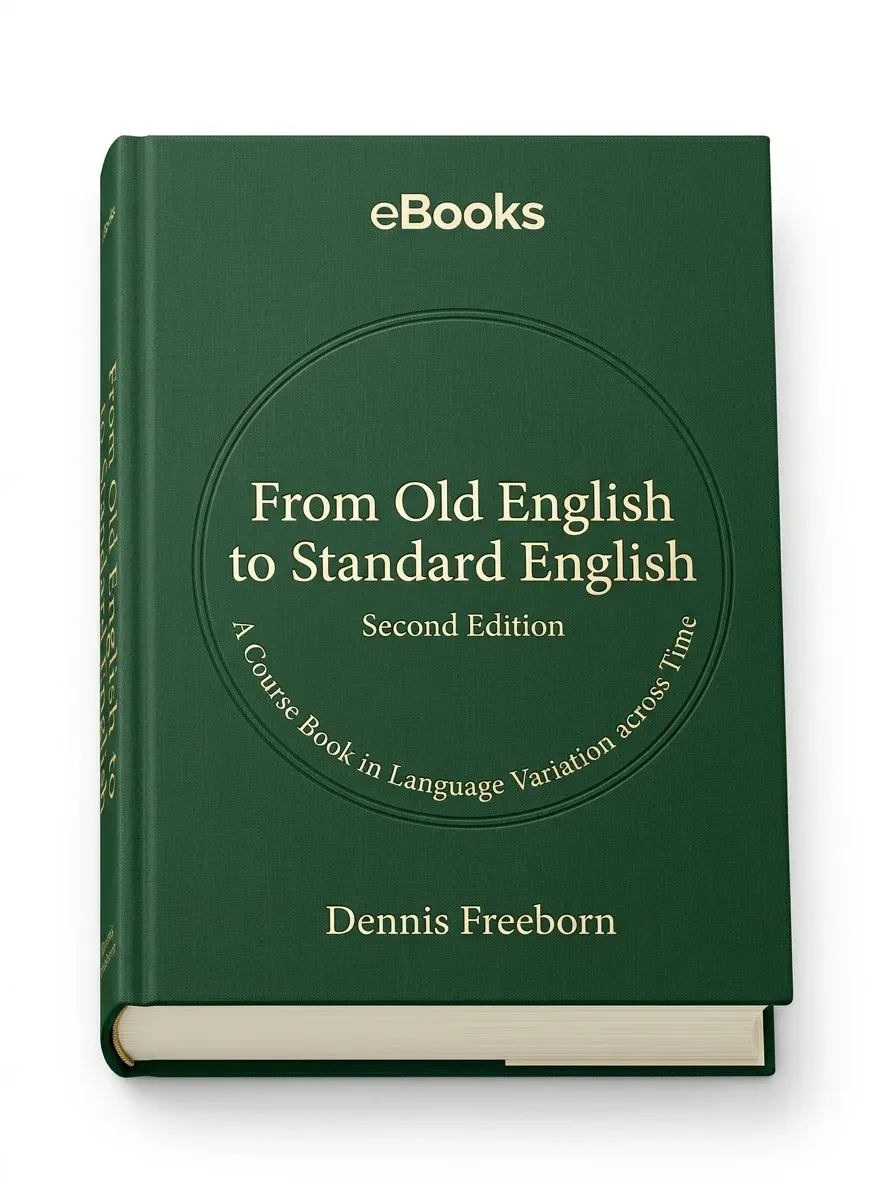
From Old English to Standard English: A Course Book in Language Variation Across Time is an essential resource for understanding how English evolved from Germanic roots to a global standard. This guide explores phonological, morphological, and syntactic shifts across centuries, bridging historical texts with modern usage. Ideal for students and linguistics enthusiasts, the book applies variationist frameworks to real-world language change, from Beowulf to BBC English.
1. Old English Foundations and Dialectal Roots
From Old English to Standard English: A Course Book in Language Variation Across Time begins with the Anglo-Saxon settlement (c. 450–1150 CE). Old English featured four main dialects—Northumbrian, Mercian, Kentish, and West Saxon—each showing distinct vowel and consonant patterns. The book traces how inflectional endings (-an, -um) marked case, gender, and number, unlike today’s analytic structure. Learners examine manuscripts like The Anglo-Saxon Chronicle to see variation in action. This foundational chapter emphasizes that “standard” English did not exist; rather, regional scribal practices shaped early written norms, setting the stage for later unification.
2. The Middle English Transition and French Influence
Following the Norman Conquest (1066), From Old English to Standard English: A Course Book in Language Variation Across Time documents the collapse of inflectional systems and the rise of French loanwords (e.g., justice, parliament). Between 1150 and 1500, English re-emerged as a literary language after centuries of Anglo-Norman dominance. The book highlights the Kentish and East Midlands dialects—Chaucer’s choice—as precursors to standardisation. Vowel reduction (schwa) blurred case endings, while word order became more fixed. Key exercises compare Ormulum and Piers Plowman, showing how social stratification (court vs. commoner) introduced lexical and grammatical variation that eventually narrowed into a London-based standard.
3. The Great Vowel Shift and Early Modern Standardisation
The chapter on Early Modern English (1500–1700) uses From Old English to Standard English: A Course Book in Language Variation Across Time to explain the Great Vowel Shift—a systematic raising of long vowels (e.g., /iː/ to /aɪ/ in time). This phonological upheaval created the sound system we recognise today, while printing press technology (Caxton, 1476) froze spellings. The book examines how London English, influenced by East Midlands and Court speech, became the prestige variety. Readers analyse Shakespeare’s First Folio and Tyndale’s Bible for variant spellings (moon/mone) and emerging grammar (loss of thou in formal contexts). Variation here is not chaos but evidence of deliberate selection.
4. The Rise of Prescriptive Grammar and Received Pronunciation
By the 18th century, From Old English to Standard English: A Course Book in Language Variation Across Time traces how grammarians (Lowth, Johnson) codified rules—banning double negatives, fixing irregular verbs—to create a “standard” for polite society. The book contrasts this prescriptive trend with natural variation in regional dialects (e.g., Northern t’house vs. the house). Simultaneously, Received Pronunciation (RP) emerged from public schools and the BBC as a social accent marker. Through case studies of Johnson’s Dictionary and Walker’s Pronouncing Dictionary, readers see how power and class institutionalised one variety over others, a process the book critically evaluates using variationist sociolinguistics.
5. Global Englishes and Digital Variation Today
The final chapter applies From Old English to Standard English: A Course Book in Language Variation Across Time to contemporary settings—World Englishes, internet slang, and text-to-speech AI. English now has no single standard; instead, overlapping norms (Indian, Nigerian, Singaporean) coexist. The book explores how Twitter, memes, and chatbots accelerate lexical change (ghosting, cheugy) and reintroduce variation (e.g., capitalization dropped for tone). Students complete fieldwork on their own speech communities, mapping features like quotative be like. The key takeaway: variation is not deviation but the engine of language. This course book equips readers to analyse English’s past—and predict its digital future.